Posts

What’s the Difference Between Series A and Series B Flanges?

Image
ASME B 16.47 is one of the American standards. It refers to one of the large-diameter steel flanges. The standard also covers the requirements about flange joint, flange bolting, flange gaskets, etc. In addition, the standard covers the design of flanges from NPS 60 to NPS 24. With the rating classifications 900, 600, 400, 300, 150, and 75, the standard ASME B 16.47 offers measurement, dimensions, marking, tolerances, and pressure temperature for the pipe flanges. ASME B16.47 standard comes in two series, Series B and Series A flanges. The differences between these flanges are: Characteristics ASME B16.47 Series A flanges are relatively thicker, heavier, and more robust than Series B flanges with the same size and pressure ratings. Hence, series A flanges can withstand extra external loading compared to the Series B flanges. Required Fasteners The fastener quality requirement for ASME B16.47 Series A flanges is lesser than the Series A. Class 150 Series A flange requires 28 bolts of 1...

What are the Benefits of Choosing Stainless Steel Flanges?

Image
Stainless steel flange   is used widely in industrial and domestic applications because of its many benefits. It is resistant to corrosion alongside the temperature looks good. The flanges made of stainless steel also offer all these benefits and much more. Flanges are an essential part of the piping valves, contractors, and other types of equipment. However, the best they offer is to provide a repair, cleaning, and access point. In a closed system, a  flanged joint   is made by bolting the gasket together, which you can flank by two flanges, resulting in a stronger seal. Here are a few benefits of choosing  stainless steel flanges : Strength Stainless steel is durable and strong, and it is one reason that it can withstand enormous pressure. On the other hand, aluminum may prove a much cheaper option. The reason is that it is soft and cannot work under high pressure. Corrosion Chemical, rust, and other factors are easily damageable metals. Therefore, when you choose ...

Main Elements of Flange

Image
The flange is a structure extension that has holes drilled into it. These holes are placed in the flange to accommodate the securing bolts. The flange joins or seals the various part of the structure. Here are a few main elements of the flange. These are: Flange dimensions Each flange ASME B16.5 comes with many standard dimensions. So if a draftsman in the US, a work preparer in Japan, or a pipefitter in Australia is speaking about the welding neck flange 6″-150#-S40 ASME B16.5, it may go over the flange. If the flange is ordered, the supplier would like to know the material quality. Like, ASTM A105 is one of the forged carbon steel flanges, while A182 would be a forged stainless steel flange. Flange applications The flange’s purpose depends on its design. The main reason is to increase the structure’s strength, like in the case of an iron beam. These are often useful in the construction of buildings and houses. You can use the flange as a guide to keeping a particular object in place....

Use of Industrial Long Weld Neck Flanges

Image
Weld neck flanges are useful extensively for all types of pipe systems. However, industrial long weld neck flanges are taken as the best option when the pipes are transferring high-pressure or high-temperature fluids or fluids that fluctuate in temperature. It is true, especially in the gas and oil industry. How to choose long weld neck flanges? Industrial long weld neck flanges offer additional reinforcements which standard  weld neck flanges  do not offer. The long neck guides the pipe into the flanges, providing them with extra strength. The extra assurance helps ensure the structure, environment safety, and people when high-pressure and high-temperature fluids are involved. The structural reinforcement provided by an industrial long weld neck flange is crucial to the stability and safety of high-pressure industrial and commercial systems. How long do weld neck flanges help? There are a few uses of weld neck flanges: Large pipe networks Be it water main, gas main, or anothe...

Plate flange vs Slip-on Flange

Image
There are many kinds of flanges available in the market like blind flanges , butt weld flanges, slip-on flanges, weld neck flanges, and more. Here in this blog, we’ll discuss slip-on vs. plate flanges. Meaning of plate flanges Plate flange is a circular, flat disc welded to the pipe’s end. It enables the flange to be bolted to another pipe. It is often referred to as the flange slip, plane flange, flat flange, etc. Two plate flanges can be bolted together with a gasket in between them, usually used in water and fuel pipelines. The pipe length is not always known while constructing a pipeline. The plates may also be welded with a slight bias to the shaft, allowing the two pipes not to match up and join. Plate flanges come with a notched finish on the inner mating surface that allows the plate to fit within the gasket material. In any given dimension, plate flange designs are standardized, apart from the materials used to manufacture them. It ensures that the fit is exactly like a 6-inc...

How to Tell whether the Stainless Steel Flange is Real?

Image
Stainless steel flange will function properly, and it all goes back to whether the flange was the right one for the job in the first place. The flange must fit in pipe joints to perform properly. A small error while choosing a flange can affect an application that may result in a costly mistake. These factors are involved while choosing the right flange for the right application to maximize its functionality. Factors used to identify stainless steel flange Below are the factors that can help to identify the stainless steel flange easily: Types It is easy to identify the type of flange by its appearance. First, you need to identify the tops by determining if the flange has socket weld, weld neck, lap joint , threaded bore, or flat face. Next, you need to identify the bottoms by determining if it has a flat or raised face that is a slightly raised section on the flange face. Materials You must choose the right material for the flange. It helps to understand the elements bett...

Why Do Forging Flanges Need Heat Treatment?

Image
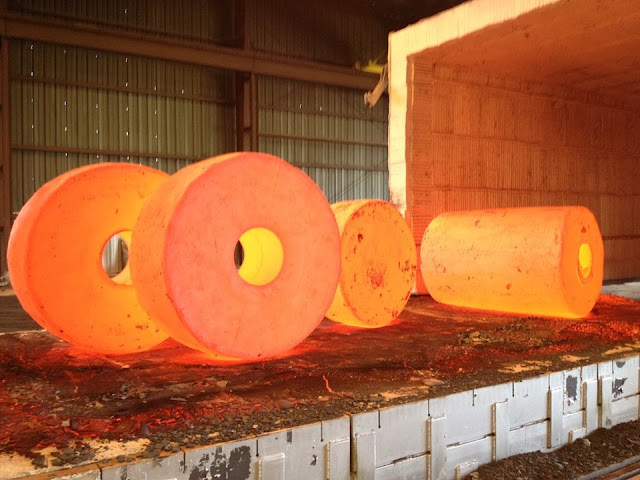
If you want to know why do forging flanges need heat treatment, you must first get an understanding of the meaning behind forgings. Forging is the use of a hand hammer, pressure equipment, or forging hammer on the mold on the heating of the metal blank force so that metal materials under the condition of non-separation plastic deformation obtain performance, size, and properties meet the requirements of parts. Need of heat treatment for the forged flange The main purpose is to refine the coarse grains, eliminate the residual stress and work hardening, reduce the hardness, improve the cutting performance, prevent the white spots while forging, and make sure about the required machinery and metal structure. Now, below are details about the heat treatment: Normalizing If you want to forge flange connections , heat treatment is the first step. Heat the forgings above the transformation temperature, form a single austenite structure, after a period of uniform temperature stability, after a ...