Posts

Showing posts with the label ASME Flanges

Importance of AWWA Flanges in Piping Systems

Image
AWWA flanges, also known as American Water Works Association flanges, play a very important function in piping systems used for water supply and treatment. These specialized flanges are designed to meet the high quality standards and requirements set by the American Water Works Association, that ensure the safety and reliable conveyance of water in municipal, industrial, and commercial applications. The importance of  AWWA flanges  lies in their ability to provide secure connections between pipes, valves, pumps, and other components, preventing leaks and ensuring the integrity of the water distribution network. By following and meeting the strictly established manufacturing standards and quality control measures, AWWA flanges help maintain the safety, efficiency, as well as sustainability of water supply networks, which helps in protecting or safeguarding public health, environmental protection, and economic development. 8 key points to understanding the importance of AWWA Fla...

What’s the Difference Between Series A and Series B Flanges?

Image
ASME B 16.47 is one of the American standards. It refers to one of the large-diameter steel flanges. The standard also covers the requirements about flange joint, flange bolting, flange gaskets, etc. In addition, the standard covers the design of flanges from NPS 60 to NPS 24. With the rating classifications 900, 600, 400, 300, 150, and 75, the standard ASME B 16.47 offers measurement, dimensions, marking, tolerances, and pressure temperature for the pipe flanges. ASME B16.47 standard comes in two series, Series B and Series A flanges. The differences between these flanges are: Characteristics ASME B16.47 Series A flanges are relatively thicker, heavier, and more robust than Series B flanges with the same size and pressure ratings. Hence, series A flanges can withstand extra external loading compared to the Series B flanges. Required Fasteners The fastener quality requirement for ASME B16.47 Series A flanges is lesser than the Series A. Class 150 Series A flange requires 28 bolts of 1...

Why Do Forging Flanges Need Heat Treatment?

Image
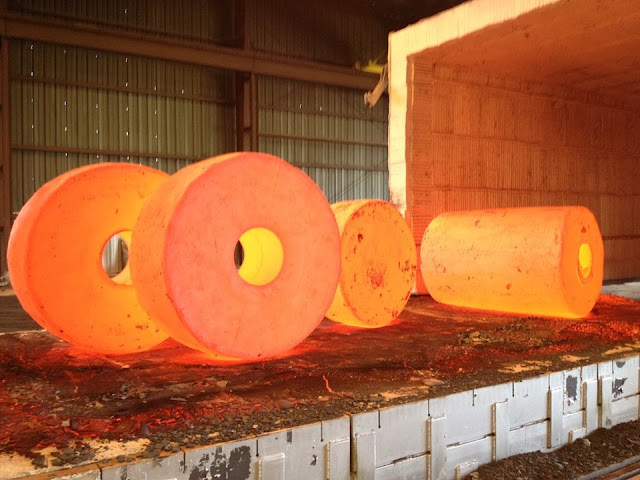
If you want to know why do forging flanges need heat treatment, you must first get an understanding of the meaning behind forgings. Forging is the use of a hand hammer, pressure equipment, or forging hammer on the mold on the heating of the metal blank force so that metal materials under the condition of non-separation plastic deformation obtain performance, size, and properties meet the requirements of parts. Need of heat treatment for the forged flange The main purpose is to refine the coarse grains, eliminate the residual stress and work hardening, reduce the hardness, improve the cutting performance, prevent the white spots while forging, and make sure about the required machinery and metal structure. Now, below are details about the heat treatment: Normalizing If you want to forge flange connections , heat treatment is the first step. Heat the forgings above the transformation temperature, form a single austenite structure, after a period of uniform temperature stability, after a ...

Effect of Temperature on Bolted Flange Assemblies

Image
Bolted flange assemblies are helpful to connect widely with different elements of the pipelines and pressure vessels. They carry process media at temperatures that vary from cryogenic to more than 1000°C. Thermal transitions and high temperatures play a vital role in the tightness of bolted flange assemblies. We can quickly encounter the unfulfilled tightness that may occur due to thermal effects. It becomes easier if the assembled components (gaskets, bolts, and flanges) are in limits, and do not undergo mechanical failure. Characterize the temperature effects The temperature during the process is bound to rise. It demands the improvement in the chemical efficiency that drives the process. It is why; components like gaskets must be able to withstand the increase very quickly. Characterizing the temperature effects on the flange bolting assemblies will always remain a crucial issue. Not only for the end-users but also for the designers as it involves complex physical laws. The reason ...

Finding the Right Pipe Flange for Your Project

Image
There are numerous essential variables purchasers ought to consider when picking pipe fittings. The materials used to construct a pipe fitting helps identify how the fitting will connect to the pipes and the pressure it can handle. Therefore, it's imperative to choose the right pipe fittings for the project despite their size. To fix the right pipe system, you should know the different types of fittings available and their properties. Here are flange fittings that can help you find a solution. Knowing the Different Types Will Help to Find the Right Pipe Flange: 1. Threaded flanges 2. Blind Flanges 3. Alloy pipe flanges Threaded flanges: These types of flanges are used in low-pressure systems. The most mainstream threaded flanges range in ½ inch to 6" standard size, yet many offer NPT threaded flanges up to 24" if necessary. These flanges are not suitable for welding temperature, which is more than 260 ℃and less than -45 ℃ of the pipeline.             ...

Flange Installation Guidelines

Image
What to look at before beginning the installation? Accessories or connections for the flange: Properly introduced flanged connections give progress fitting to join substitute funneling materials, a mechanical way to interface with valves and other hardware, and join channeling frameworks where continuous destroying might be required. The notched substance of the flange gives a fluid-tight seal on the gasket when flanges are appropriately gathered, upheld, and legitimate torque is applied to the bolts. Gaskets: Full face 1/8" thick elastomeric material with a Shore A Durometer hardness of 50-70; gasket material is chosen should be viable with application and liquids passed on. Varieties in a gasket material and shore hardness may influence the fixing torque required. Dimensions of the flange :   Dimensions are more than after according to the ANSI Flange dimensions . Flange ring bolt opening dimensions adjust to ANSI B 16.5 Class 150 bolt design. Strung flange center points ...