Posts

Showing posts with the label ANSI Flange

Importance of AWWA Flanges in Piping Systems

Image
AWWA flanges, also known as American Water Works Association flanges, play a very important function in piping systems used for water supply and treatment. These specialized flanges are designed to meet the high quality standards and requirements set by the American Water Works Association, that ensure the safety and reliable conveyance of water in municipal, industrial, and commercial applications. The importance of  AWWA flanges  lies in their ability to provide secure connections between pipes, valves, pumps, and other components, preventing leaks and ensuring the integrity of the water distribution network. By following and meeting the strictly established manufacturing standards and quality control measures, AWWA flanges help maintain the safety, efficiency, as well as sustainability of water supply networks, which helps in protecting or safeguarding public health, environmental protection, and economic development. 8 key points to understanding the importance of AWWA Fla...

Understanding ANSI Flange Standards in the Industrial World

Image
Ever wonder how industries work smoothly? Well, ANSI flanges are like the super important puzzle pieces that connect pipes and make everything run seamlessly. In this blog, we’ll make it easy for you to understand   ANSI flange dimensions   and standards. We’ll cover the basics, types, their use, and how to pick the right one. Whether you’re a pro or just starting out in the industrial world, stick with us as we explain ANSI flange standards in a way that’s easy and clear for you! What are ANSI flange standards? ANSI flange standards are like the unsung heroes of industrial connections. Imagine them as the universal language that different parts of a machine speak to each other. These standards, particularly the ANSI B16 series, provide guidelines for the design, dimensions, and materials of flanges, the essential components that connect pipes and other equipment. Key components of ANSI Flange standards 1. Types of Flanges There are different types of flanges, each serving a u...

Main Elements of Flange

Image
The flange is a structure extension that has holes drilled into it. These holes are placed in the flange to accommodate the securing bolts. The flange joins or seals the various part of the structure. Here are a few main elements of the flange. These are: Flange dimensions Each flange ASME B16.5 comes with many standard dimensions. So if a draftsman in the US, a work preparer in Japan, or a pipefitter in Australia is speaking about the welding neck flange 6″-150#-S40 ASME B16.5, it may go over the flange. If the flange is ordered, the supplier would like to know the material quality. Like, ASTM A105 is one of the forged carbon steel flanges, while A182 would be a forged stainless steel flange. Flange applications The flange’s purpose depends on its design. The main reason is to increase the structure’s strength, like in the case of an iron beam. These are often useful in the construction of buildings and houses. You can use the flange as a guide to keeping a particular object in place....

Why Do Forging Flanges Need Heat Treatment?

Image
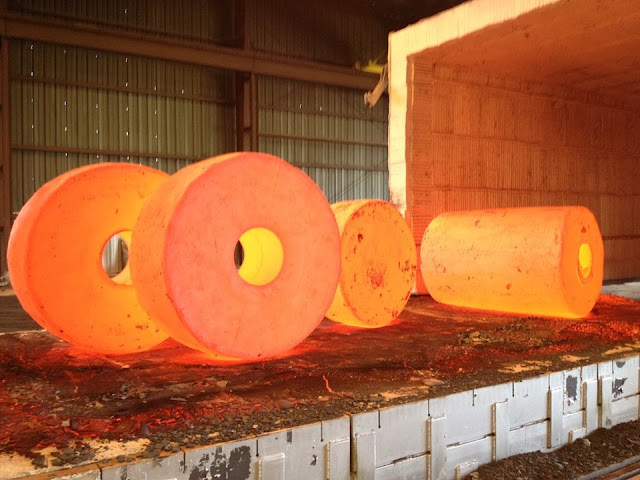
If you want to know why do forging flanges need heat treatment, you must first get an understanding of the meaning behind forgings. Forging is the use of a hand hammer, pressure equipment, or forging hammer on the mold on the heating of the metal blank force so that metal materials under the condition of non-separation plastic deformation obtain performance, size, and properties meet the requirements of parts. Need of heat treatment for the forged flange The main purpose is to refine the coarse grains, eliminate the residual stress and work hardening, reduce the hardness, improve the cutting performance, prevent the white spots while forging, and make sure about the required machinery and metal structure. Now, below are details about the heat treatment: Normalizing If you want to forge flange connections , heat treatment is the first step. Heat the forgings above the transformation temperature, form a single austenite structure, after a period of uniform temperature stability, after a ...

What Is The Scope And Purpose Of Installing Flange Guards?

Image
Flange guards act as protective shields that are useful in preventing the leakage of the various harmful chemicals from the joints of the flanges, valves, pipelines, etc. The chemical industries work at risk each day. Many pharmaceuticals and chemical industries work with different types like caustics, chlorine, alkaline, acid, or other harmful chemicals that are highly reactive with natural substances. It may also cause damage to the machine and man and may result in explosions. If you want to avoid such situations, you should go for the installation of  custom flange  guards at the joints of the pipelines as it is the safest option. How to fix flange guards at the pipeline’s joint Here are some ways to fix flange guards at the pipeline’s joints: Preventing spray-outs The device is useful enough to help block the path of any spray out from the joints of the valves and pipelines. It is an effective way to prevent situations that may lead to injury and damage. Prevent...