Posts

Showing posts with the label flange bolting

The Ultimate Guide to Bolt Charts for Flanges

Image
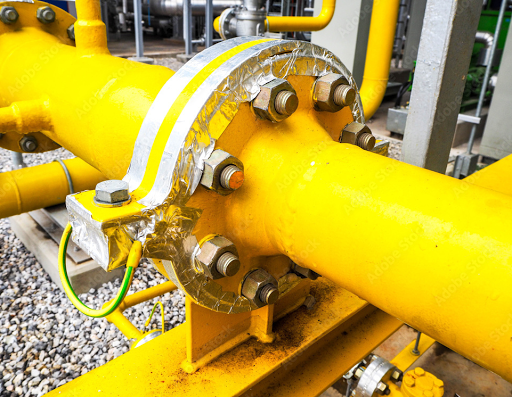
Flanges may not be the first thing that comes to mind when you think of industrial equipment; however, they are essential to ensure lots of things work well and don’t cause problems. Bolting these flanges together is essential, and that’s where bolt charts come into play. In this straightforward guide, we’ll break down everything you need to know about understanding  bolt charts for flanges  without getting too technical. What are flanges, and why do they matter? First things first, let’s understand what flanges are. Flanges are like the connectors that join different parts of a system, such as pipes, valves, or equipment, securely. They find usage in various industries, including oil and gas, chemical, and manufacturing. Flanges create a tight seal to prevent leaks and allow for easy maintenance. So, why are flanges so important? Imagine if you had a leaking pipe in your home — it would be a disaster, right? The same goes for industries; a leaking flange can lead to costly do...

Main Elements of Flange

Image
The flange is a structure extension that has holes drilled into it. These holes are placed in the flange to accommodate the securing bolts. The flange joins or seals the various part of the structure. Here are a few main elements of the flange. These are: Flange dimensions Each flange ASME B16.5 comes with many standard dimensions. So if a draftsman in the US, a work preparer in Japan, or a pipefitter in Australia is speaking about the welding neck flange 6″-150#-S40 ASME B16.5, it may go over the flange. If the flange is ordered, the supplier would like to know the material quality. Like, ASTM A105 is one of the forged carbon steel flanges, while A182 would be a forged stainless steel flange. Flange applications The flange’s purpose depends on its design. The main reason is to increase the structure’s strength, like in the case of an iron beam. These are often useful in the construction of buildings and houses. You can use the flange as a guide to keeping a particular object in place....

Plate flange vs Slip-on Flange

Image
There are many kinds of flanges available in the market like blind flanges , butt weld flanges, slip-on flanges, weld neck flanges, and more. Here in this blog, we’ll discuss slip-on vs. plate flanges. Meaning of plate flanges Plate flange is a circular, flat disc welded to the pipe’s end. It enables the flange to be bolted to another pipe. It is often referred to as the flange slip, plane flange, flat flange, etc. Two plate flanges can be bolted together with a gasket in between them, usually used in water and fuel pipelines. The pipe length is not always known while constructing a pipeline. The plates may also be welded with a slight bias to the shaft, allowing the two pipes not to match up and join. Plate flanges come with a notched finish on the inner mating surface that allows the plate to fit within the gasket material. In any given dimension, plate flange designs are standardized, apart from the materials used to manufacture them. It ensures that the fit is exactly like a 6-inc...

Why Do Forging Flanges Need Heat Treatment?

Image
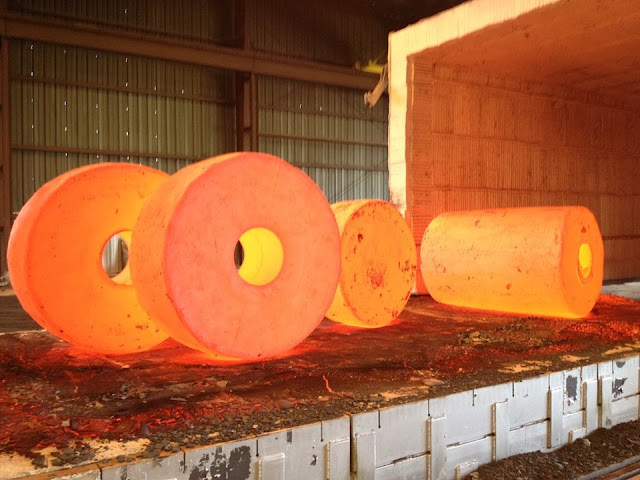
If you want to know why do forging flanges need heat treatment, you must first get an understanding of the meaning behind forgings. Forging is the use of a hand hammer, pressure equipment, or forging hammer on the mold on the heating of the metal blank force so that metal materials under the condition of non-separation plastic deformation obtain performance, size, and properties meet the requirements of parts. Need of heat treatment for the forged flange The main purpose is to refine the coarse grains, eliminate the residual stress and work hardening, reduce the hardness, improve the cutting performance, prevent the white spots while forging, and make sure about the required machinery and metal structure. Now, below are details about the heat treatment: Normalizing If you want to forge flange connections , heat treatment is the first step. Heat the forgings above the transformation temperature, form a single austenite structure, after a period of uniform temperature stability, after a ...

What Are The Different Types Of Titanium Flanges?

Image
Titanium flanges are one of the materials that help to prevent seawater corrosion. The flanges are lightweight, corrosion-resistant, and strong. It is used for different applications like gas industry, petrochemical equipment, glasses, military, oil industry, medical equipment, and much more. One of the known things about flanges is their joining methods after welding. It is widely helpful when the joints need dismantling. It offers convenience and flexibility for maintenance. It helps to connect the pipes with different components, valves, and others. The flanged joint comes with components like gaskets and flange bolting . They are effective metals in the chemical industry. Different kinds of Titanium Flanges Titanium comes with low density. It is a strong and lustrous material with a silver shadow. The product is strengthening with the usual heat temperature that provides maximum chemical properties. The products are used in different industries like sugar mills, textile machi...